The Chill at the Edge: A Window-Dressing Audit for UK Homes
Photo: Tim Sheerman-Chase, CC BY 2.0, via Wikimedia Commons
Most UK homes do not lose heat through one dramatic hole. They lose it in a hundred small, polite gaps: above a curtain track, behind a blind, under a too-short hem, around a bathroom shutter that has never quite sat flat. By mid-November 2026, when the heating is on and the windows are cold, those gaps start to matter. Before you shop for a bigger radiator, spend an hour with the window dressings.
Start at the window, not the radiator
A radiator under a window is not automatically a design mistake. Cold air falls off the glass, the radiator warms it, and the room feels less stuffy. The problem comes when the curtain, blind or pelmet interferes with that loop. A floor-length curtain tucked behind a radiator traps warm air against the glass. A blind mounted too far from the wall lets a cold curtain of air slide down behind it. A track with a gap at each end turns a cosy living room into a slow convection loop.
The goal is not to seal a room like a flask. UK homes need ventilation, especially in kitchens and bathrooms. The goal is to stop the obvious leaks, keep condensation off the coldest surfaces and let the heating do less work.
Four places to run your hand
Do this on a cold evening with the heating on and the curtains closed. Use the back of your hand, not your palm, and check:
- The top edge. Is there a gap between the track or pole and the ceiling or wall? Can you feel cold air moving?
- The sides. Do the curtains return to the wall, or do they hang flat with a gap at each edge?
- The bottom. Does the hem sit on the radiator, the sill or the floor? Is it wet or discoloured?
- Behind the blind. If you have a roller or Roman blind, is it mounted inside the recess or over it? Is there a visible cold stripe at the bottom?
If you find damp patches, black spotting or swollen window reveals, treat that as a ventilation and condensation issue first. Better dressings help, but they are not a substitute for opening a trickle vent or using an extractor fan.
Living room: the biggest curtain in the house
The living room often has the widest window and the most expensive curtain. It is also where heat loss is easiest to ignore because the sofa faces the other way.
Before: The pole is fitted well above the window, but the curtains stop short of the sill. The radiator sits under the window, and the curtain hem is tucked behind it. On cold evenings the room feels draughty at ankle height.
After: Lower the pole or add a pelmet to close the top gap. Add curtain returns or wall brackets so the edges sit closer to the wall. If the radiator is under the window, use sill-length curtains or a blind that clears the radiator. Keep floor-length curtains pulled clear when the heating is on.
Quick checks:
- Close the curtains and feel the top and side edges.
- Look for a cold stripe at the bottom of the window.
- Check that the curtain does not cover a radiator grille or sit against a hot surface.
- Add thermal lining or interlining if the fabric is thin and the window is single glazed.
Bedroom: condensation and the cold edge
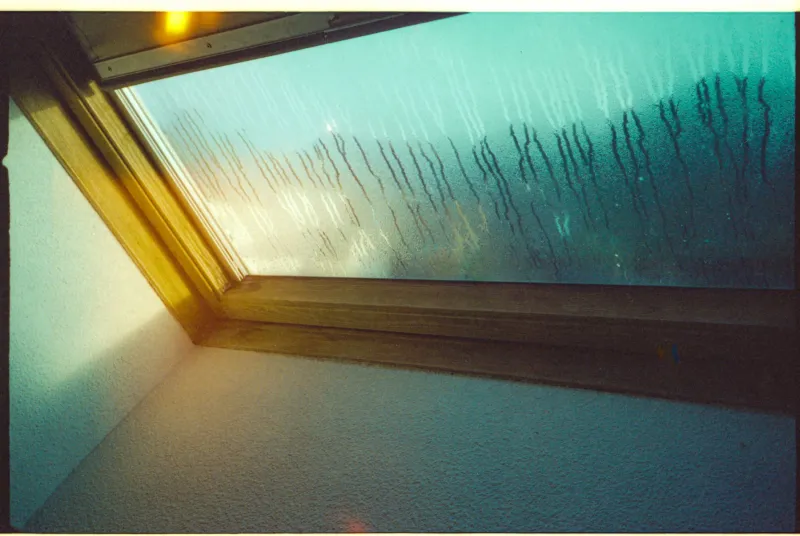
Bedrooms are where condensation shows up first. Warm, moist air from breathing meets cold glass, and by morning the window is running with water. Heavy curtains can make it worse if they keep the window cold and block the airflow that would dry it.
Before: A roller blind sits inside the recess with a finger-width gap at each side. The curtains are decorative and unlined. The window is wet every morning and the sill has started to blister.
After: Move the blind outside the recess or add side channels if the blind allows. Choose a lining that suits the room rather than a blackout layer on every window. Open the curtains and blind each morning, wipe the glass and leave the window slightly ventilated if the room has trickle vents.
Quick checks:
- Is the blind mounted inside the recess with cold air bypassing it?
- Do the curtains touch the wall or leave a gap?
- Is there a radiator directly behind the curtain hem?
- Does the window have a working trickle vent, and is it open?
Kitchen and bathroom: moisture first
In kitchens and bathrooms, the dressing has to cope with steam. Pretty fabric is fine if it can be cleaned and dried. A blind that stays damp is not.
Before: A fabric Roman blind sits close to a shower, and a café curtain hangs over the sink. The blind is mouldy at the bottom and the window is wet after every shower.
After: Use a moisture-tolerant blind, leave it fully open after showers and wipe the window and frame. Keep fabric away from the hob and sink splash zone. If the room has an extractor fan, use it every time and let the dressing dry before closing it.
Quick checks:
- Is the blind or curtain damp to the touch?
- Does the dressing block the extractor or window vent?
- Is there mould on the hem, track or window reveal?
- Can the window be opened easily with the dressing in place?
Hall, landing and the door at the end
Hallways are often the coldest part of a UK home because they have the front door, the stairs and a window that nobody sits beside. A curtain that is never closed is not doing much. If the hall window is single glazed and draughty, a simple blind or a well-fitted curtain can take the edge off.
Before: A decorative curtain hangs on a pole with a wide gap at each side and never gets drawn. The landing window has no covering at all.
After: Fit a track or pole that allows the curtain to overlap the wall. Add a thermal lining if the window is cold. If the window is small, a well-fitted Roman blind may be more practical than a curtain that collects dust on the stairs.
The fixes worth doing first
You do not need a full re-dress. Start with the cheapest interventions:
- Adjust the drop. A curtain that is 5cm too short at the sill is a draught. A curtain that puddles on the floor is a dust trap. Fix the hem before buying new fabric.
- Close the top gap. A pelmet, a ceiling-fixed track or a simple fabric valance can stop warm air escaping over the curtain.
- Add returns. Wall brackets or return plates pull the curtain edges back towards the wall.
- Use linings wisely. Thermal linings help, but they work best when the curtain is fitted properly. A lined curtain with a gap at the top is still a gap.
- Keep radiators clear. Do not box in a radiator or trap it behind a long curtain. If the curtain must be long, tie it back or choose a different window covering.
- Deal with condensation daily. Open curtains and blinds in the morning, wipe the glass, and ventilate the room. A dressing cannot dry a window on its own.
A five-minute winter routine
Each morning, open the curtains and blinds fully. Wipe the bottom of the glass and the window frame if there is condensation. Leave bathroom and kitchen dressings open until the room has dried. Once a week, feel the edges of each curtain and blind with the heating on. Once a month, check the track, cord and hem for damp or mould.
A bigger radiator may still be the right answer in a cold room, but it is rarely the first answer. The edge of the curtain, the gap above the track and the cold stripe behind the blind are the quiet places where winter gets in. Fix those first, and the room will feel warmer before the boiler has done anything different.